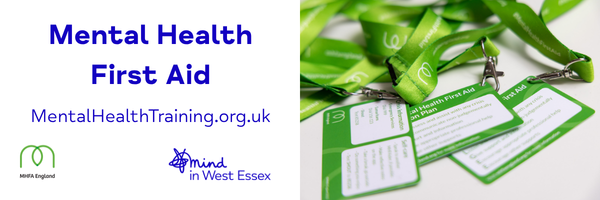
Become a Mental Health First Aider (MHFAider®) and be trained to provide first-level mental health support and early intervention – whether it’s in your workplace, a volunteer role, or the community.
You’ll be certified as a MHFAider for 3 years and also gain access to exclusive resources, ongoing learning, and 24/7 digital support.
Mind in West Essex offer Mental Health First Aid training, with the next course taking place in Harlow on September 23 and 24.
Throughout this two-day training course, you’ll gain:
The knowledge, awareness and skills to spot signs of someone experiencing poor mental health
The confidence to start a conversation and signpost someone to appropriate help
The support to feel empowered and motivated to carry out the role.
Essex County Council is looking for volunteer Public Contributors to support the work of its Health Determinants Research Collaboration.
This is a voluntary role rather than paid employment. It offers local people an opportunity to use their lived experience and perspectives to help shape research intended to improve health and wellbeing across Essex.
Public Contributors will help ensure that research reflects the issues that matter to residents and communities, and that local people have a meaningful voice in how it is developed.
Further information about the role and how to apply is available here:
The Essex Alliance is sharing this information on behalf of Renew Counselling.
Renew Counselling and Training is a local charity providing professional counselling for children, young people and adults. Many of the people who come to us are facing overwhelming life pressures. For some, the cost of counselling can be a barrier to getting the help they need at the time they need it most.
That is why we are taking part in the Christmas Big Give through our Heads Together This Winter campaign, raising vital funds for Renew’s Counselling Bursary Fund.
We are seeking £2,500 in pledges from local businesses and community supporters. Every pledge, large or small, will help us reach that target. Through the Big Give, these pledges can then be matched, creating the opportunity to raise £5,000 to help local people access counselling when cost would otherwise prevent them from receiving support.
By supporting this campaign, your business would be helping to ensure that professional counselling is available to people in our community when they need it most.
Your pledge could help:
A child receive specialist counselling after experiencing trauma.
A young person access support before problems escalate.
An adult facing crisis begin their journey towards hope and recovery.
If making a pledge isn’t possible at this time, you can still make a meaningful difference by sharing our campaign with your wider business network. Every introduction and every share helps us reach more people who may be able to support this campaign, bringing us one step closer to our £2,500 pledge target and helping more local people access affordable counselling.
Whether through a pledge or by sharing our campaign with your wider network, your support could make a real difference. If you feel your business is able to help, we’d be incredibly grateful for your support.
Thank you for taking the time to consider supporting local people this winter. Together, we can ensure that more people receive the counselling they need, when they need it most.
The Robin Cancer Trust is inviting people across Essex to pull on their brightest pants and take part in its much-loved Pants to Cancer Walk, returning to Clacton-on-Sea on Sunday 20th September 2026.
Now in its sixth year, the charity event encourages participants to wear their underwear over their clothes while proudly shouting “Pants to Cancer!” as they walk together to raise vital awareness and funds for people affected by testicular, ovarian and germ cell cancers.
The family-friendly event follows a 7-mile route from Clacton Pier to Walton Pier, with the option to complete the full 14-mile round trip for those looking for an extra challenge. Participants are encouraged to wear colourful pants, knickers, boxers or even bloomers over their outfits, creating a fun and eye-catching spectacle along the Essex seafront.
Entry costs £12 for adults and £6 for under-18s, with every participant receiving a medal. The walk is suitable for wheelchair users and well-behaved dogs on leads are also welcome.
Toby Freeman, Founder and CEO of The Robin Cancer Trust, said: “We’re so excited to bring the Pants to Cancer walk back for its sixth year. Last year’s event welcomed more than 100 participants, making it our biggest walk yet, and it was fantastic to see so many people getting
behind our mission in such a fun and memorable way.”
“Whether you’re walking in superhero pants, colourful boxers or giant novelty bloomers, every step helps us raise awareness of cancers that are often diagnosed too late. We can’t wait to see more people joining us this September to help save lives.”
This year’s walk is being sponsored by East Coast 5 and the Daniel Connal Partnership, but the charity is currently inviting more local businesses to sponsor the event or attend with their staff.
Participants are encouraged to fundraise, with every pound helping The Robin Cancer Trust continue its life-saving work through awareness campaigns, educational talks in schools, colleges and workplaces, and support services for people and families affected by testicular, ovarian and germ cell cancers. A £10 donation helps the charity reach thousands of young people through its digital awareness campaigns, £25 provides a Thriver Support Pack to someone recently diagnosed and £50 enables the charity to deliver a life-saving cancer awareness talk.
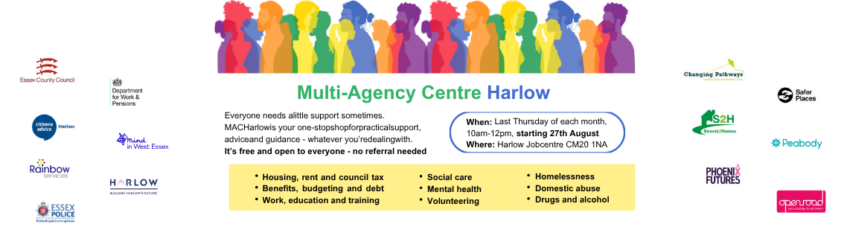
The Harlow Multi-Agency Centre (MAC) drop-in service is now ready to launch!
The aim of the MAC is to bring together a range of partner agencies in one place, making it easier for people to access the advice, guidance and support they need. By working together, the MAC can provide a more joined-up approach and improve outcomes for the people they support.
Everyone needs a little support sometimes. MAC Harlow is your one-stop shop for practical support, advice and guidance – whatever you’re dealing with. This could be:
Housing, rent and council tax
Benefits, budgeting and debt
Work, education and training
Social care
Mental health
Volunteering
Homelessness
Domestic abuse
Drugs and alcohol
It’s free and open to everyone – no referral needed.
When: Last Thursday of each month from 10:00-12:00, starting 27th August 2026
A team of researchers at the University of Essex in collaboration with Essex based local authority, third sector and NHS staff as well as people with lived experience of mental distress have developed a signposting tool “CoSign”. The development process was supported by NIHR ARC East of England.
What is CoSign?
CoSign was designed to support individuals over 18 to identify wider determinants (e.g. relationships, work, family, housing etc)that may be triggering their current emotional distress and to facilitate signposting to appropriate community-based support. CoSign is not an assessment or diagnosis tool and is not an outcome measure. Neither is CoSign an asset map or attempting to replace existing asset maps and search tools, since the main aim of CoSign is to help users identify what kind of support to start looking for rather than to provide an exhaustive list of support services. The signposts generated by CoSign signpost individuals to support/services in Essexor national advice services that match the user’s specific challenges. Users are also directed to the Essex Map, Frontline and other local maps for more detailed, localised searches.
Although designed for individual use, CoSign could also be used by professionals (e.g. social prescribers, community workers, GPs, student support workers) working collaboratively with clients.
The question items in CoSign have been selected through a rigorous process using statistical techniques. The statistical analysis used data from the Understanding Society: UK Household Longitudinal Survey. CoSign is ready for use in a pilot phase and feedback is being collected from users through an evaluation project.
The Essex Alliance is sharing this funding opportunity on behalf of Essex County Council.
The Families First Neighbourhood Grants Programme (FFNGP) is a £2.5 million grant programme which will fund targeted early intervention support for children, young people and families. The programme is funded through the Department for Education’s Families First Partnership Policy.
Eligible organisations can apply for a grant from £15,000 up to £60,000.
All funding projects and programmes will run for 30 months (two and a half years). They are required to start 1 October 2026 and finish 31 March 2029.
Who Can Apply
Applications are invited from voluntary and community organisations and not-for-profit organisations, including:
voluntary and community sector enterprise (VCSE) organisations
registered charities
community interest companies (CICs)
not-for-profit organisations limited by guarantee
charitable incorporated organisations (CIOs)
community benefit societies or co-operative societies
What It Can Fund
The FFNGP will fund targeted early intervention projects and programmes that enable children and families to:
address challenges early
build resilience
achieve positive and sustainable outcomes
Applications can be focused on direct work with children (five years plus), young people, parents and carers or a combination of those through whole family support.
We will fund projects and programmes that are already active, or have recently been delivered, and are known to achieve good outcomes.
Where It Covers
The grants programme covers the 12 districts within our administrative area (excluding Southend and Thurrock).
For the purpose of the FFNGP, a neighbourhood means a clearly defined local area within Essex. This includes a:
housing estate
ward
village
town
Applicants must explain why a neighbourhood has been chosen and how the proposed activity responds to local need. Prioritisation will be given to applications which target areas where need and demand levels are greatest.
How to Apply
The application window is open from Thursday 9 July 2026 until Monday 17 August 2026.
The Essex Alliance is sharing this information on behalf of the Essex Water Safety Forum and the RNLI.
The UK is currently experiencing periods of extreme hot weather, resulting in a significant increase in visitor numbers to coastal areas and inland waterways. When air temperatures reach 25 degrees or above, the risks of drowning increases significantly. It is therefore important that residents and visitors are reminded of key safety messages, including supervising children around water, and understanding the risks associated with open water swimming and other water-based activities.
The Essex Water Safety Forum is calling on individuals, local businesses and organisations to support the RNLI Water Safety Ambassador Scheme – a vital initiative aimed at promoting water safety and saving lives across our county.
Is your business or organisation located near water? Do you spend time on or near areas of water? If so, you could help save lives by signing up to the RNLI Water Safety Local Ambassadors scheme and promoting key water safety messaging. You’ll receive information and resources to share with customers, members of the public, friends and family – whether it’s via a conversation, a poster on display, or on social media. You can help champion water safety and raise greater awareness within your local community.
To find out more and sign up, please visit the RNLI website.
Why It Matters:
Essex has one of the longest coastlines in the UK, making water safety a year-round priority
The RNLI Ambassador Scheme provides resources and training to help spread life-saving messages
What You Can Do:
Sign up to the RNLI Water Safety Ambassador Scheme
Share water safety messages in your communications
Encourage colleagues and partners to get involved
Let’s work together to make Essex safer for everyone – on the coast, by the rivers, and around our lakes.
The Essex Alliance is sharing this opportunity on behalf of Mind in West Essex.
Mind in West Essex have a few places remaining for their Mental Health First Aider (MHFAider®) training on July 29-30! 📆
The 2-day course will train you to provide first-level support and early intervention – whether it’s in your workplace, a volunteer role, or the community.
You’ll gain:
The knowledge, awareness and skills to spot signs of a person experiencing poor mental health;
The confidence to start a conversation and signpost a person to appropriate help;
The support to feel empowered and motivated to carry out the role.
After the course, you’ll be able to join England’s largest community of trained MHFAiders – gaining access to exclusive resources, ongoing learning, and 24/7 digital support.