Gold Geese, a small, local charity supporting families facing childhood cancer, is encouraging the community to learn the signs and symptoms of childhood cancer and help spread the word.
September is Childhood Cancer Awareness Month, and around 1,900 children in the UK are diagnosed with cancer each year. Gold Geese operates across mid and south Essex and this year, they have been raising awareness of childhood cancer from as far as Maldon to Brentwood and Chelmsford to Southend. To raise awareness, local businesses and schools are encouraged to display Gold Geese signs and symptoms posters and, in some cases, go big with their gold decorations (gold is the ribbon colour for childhood cancer awareness).
Gold Geese has organised a bumper number of events this month to help raise awareness and funds for its support:
On Saturday, September 5, a special convoy of more than 100 gold and yellow cars toured the streets of Leigh-on-Sea, Chalkwell and Southend to raise awareness of childhood cancer
The charity has also collaborated with Leigh-on-Sea Brewery to develop a special Gold Geese beer, with 10% of every purchase going directly to the charity. A number of Gold dads took part in making the first brew and attended the launch party this weekend. The beer will be available to buy at several local venues across mid and south Essex.
Leigh Marina will turn gold during Leigh Regatta on September 12 and 13, with a family fun day raising funds for Gold Geese
On Wednesday, September 16, CEO Katie will embark on a solo eight-day fundraising trek across the width of Essex, in remembrance of the Gold children who have passed away. Donations can be made at www.justgiving.com/page/katie-walks-essex
Katie is hosting a ‘signs and symptoms Zoom training’ event for parents, teachers, nursery managers and medical professionals
On September 26, Legra Tap are hosting a closing party, with music from singer Eleanor Hudson and Tony Jefford from the band Jackie Wilson Says. Tickets are available at Legra Tap X Gold Geese Party tickets
Katie Southgate, CEO and founder of Gold Geese, said: “We’d love to see as many people as possible join our events this month. If you’d like to support our campaign at school or work, you could wear yellow or gold for the day, hold a bake sale or put up one of our posters.
“Just like geese stick together on their epic journeys, we’re showing our Gold families that the whole community supports them and we fly together.”
Free symptom awareness posters are available to collect from Metro Bank in Southend and Chelmsford, or email fundraising@goldgeese.org to arrange collection.
The Crisis and Resilience Fund helps households who are likely to suffer financial crisis to improve their financial wellbeing, build resilience and address the causes of financial hardship. As part of this, we have released a Prior Information Notice (PIN) outlining plans to invest in financial information, advice and guidance provision for residents.
We are seeking feedback to help shape the procurement process and encourage community groups to work together under a lead provider organisation.
Please share this opportunity with teams and community groups. Further details are on the Government website.
Support is also available for residents facing immediate financial pressures. If the residents you work with live in the Essex County Council area, they may be able to claim support for heating oil payments if they are unable to meet current prices. The crisis payment service will review their finances and, where needed, provide support towards the additional cost. We would recommend that residents contact us well in advance of usual purchase time to ensure oil can be purchased and delivered as expected.
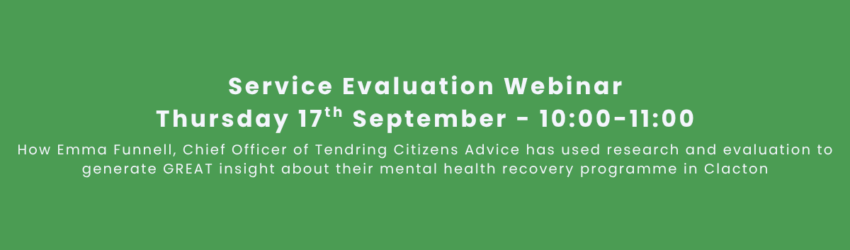
In September the Greater Essex Research Community of Practice is hosting Emma Funnell, the Chief Officer for Citizens Advice Tendring, who will deliver a session about service evaluation together with colleagues from University College London and Essex County Council.
Emma will explain how she has worked in collaboration with Essex County Council and University College London to create an evaluation that has helped deliver real insight on a mental health recovery programme.
The session will cover:
How developing a theory of change helped add value to communicating the value of the programme and the monitoring work.
How this led to Emma working with Dr Rachel Benchekroun from University College London to do a piece of realist evaluation, which has revealed further insights from conversations with programme staff and programme participants.
And how colleagues are looking to communicate the findings to appeal to a range of audiences – by linking
The evaluation findings into wider theories about social networks, social infrastructure and recovery journeys.
And inviting members of the voluntary and community sector into a follow-up informal workshop to discuss insights and lessons learned on supporting people back into work.
This webinar will be relevant to anyone in the VCSE sector with an interest in evaluation, mental health recovery and supporting people back into work.
Please email mike.williams@essex.gov.uk for an invite.
The Essex Alliance is sharing this training opportunity on behalf of Mind in West Essex.
The Essentials workshop is the foundation for workplace wellbeing, and it’s at the core of everything we do at The Mental Health Toolkit.
This half-day session takes you through the Mental Health Continuum – the spectrum of mental health that we are all on – and introduces you to the Emotional Needs & Resources approach.
Unmet emotional needs trigger symptoms of mental ill health. Understanding how to meet them helps you understand what you need to be well, and enables you to take care of yourself and those around you.
The dates below have been fully funded by Essex County Council, and are offered free of charge for staff and volunteers of any VCSE organisations working in Essex.
Bellringers across Essex will open the doors to historic local bell towers as part of the Heritage Open Days 2026. Visitors will have the opportunity to inside a ringing room, meet the bellringers and discover how change ringing works.
Check out the participating towers by contacting news@eacr.org.uk
Stagetext, a deaf-led charity based in Colchester, has some free deaf awareness training for people working or volunteering in Essex in arts, culture, museums or heritage venues.
When: Tuesday 22nd September Where: Chelmsford City Museum, Wells Suite in Essex Time: There are two available sessions, in the morning or afternoon: 10.00am to 12:30pm or 1:30pm to 4.00pm. How to book: Click on the link below to find out more.
Ace Music Therapy have announced the next 2 blocks of free Wiggles and Jiggles groups for babies and their mums in Chelmsford this autumn.
This fun and friendly group combines music, movement, and baby massage to support babies’ early development while giving parents a chance to connect, chat, and enjoy time with their little ones.
Designed and delivered by a qualified Music Therapist and Paediatric Physiotherapist, the sessions combine live music, baby massage & movement to support childhood development, enhance parent-child bonds, and improve maternal mental health.
This evidence-based program uses music as a clinical tool to promote communication, emotional regulation, creativity, and self-confidence. These benefits are especially impactful for mothers experiencing postnatal depression (PND) or isolation, as research demonstrates that structured baby classes improve maternal mood, enhance early interactions, and foster secure attachments. Babies gain from the developmental benefits of live music and tactile activities.
The sessions will be led by Amelia – our CEO & HCPC Registered Music Therapist and Natalie – Paediatric Physiotherapist from Happy Little Feet. The sessions are gentle, engaging, and accessible for babies of all abilities, including those with special needs, from 12 weeks to pre-crawling.
The group will run for 6 weeks, with resources given to parents for practising some of the skills learnt in the group at home. The group can accommodate up to 8 babies and their mums (one parent should attend the entire block where possible.)
Please note – our aim with this group is to reach the people who need it most – Please do not share the group details on social media at this time, we are trying to reach social prescribers, family support teams and those who work with vulnerable parents, who can signpost the mothers they support to our group.
September – October Group (For Babies that will be between 12 weeks + pre-crawling between these dates)
We are sharing this information on behalf of Fareport.
We are delighted that Essex County Council have agreed funding for our short training course, focused on Digital Skills for the Community and Voluntary Sector.
The course is designed specifically for charities, community groups and VCSE organisations in Essex, and covers practical digital skills in cyber security and GDPR, digital marketing and storytelling, online income generation, data and impact reporting, and using automation and AI responsibly within mission‑led organisations.
The course will start on the 6th of October, and runs 1 day a week, live online with our expert trainers.
If someone in your team or your network would benefit from the training, you can find all the details on our website:
Parents 1st UK are looking for an exceptional individual to lead our Board of Trustees and help shape the future of our charity as we continue to grow, strengthen our impact and support more parents and families.
If you share our values and can bring strategic insight, sound judgement and a commitment to making a difference, we’d love to hear from you.
The Robin Cancer Trust and InColchester BID are inviting local businesses to join them at an upcoming September event, featuring a relaxed afternoon of mini-golf, food, drinks and networking in support of life-saving cancer awareness.
Taking place on 10th September 2026 from 4pm to 8pm at Putt in the Park in Colchester, the Putt & Connect event will bring together local businesses for an informal social, designed to help teams connect, build relationships and support an important cause.
Open to any business or organisation, the event offers an alternative approach to traditional networking, with no presentations, formal introductions or golf experience required. Attendees can enjoy a round of mini-golf, refreshments and the opportunity to meet other local business owners, teams and potential partners in a relaxed setting.
The event has been created by The Robin Cancer Trust and InColchester BID to
highlight the important role businesses can play in supporting their local communities, while raising awareness of testicular, ovarian and germ cell cancers and the charity’s work to educate and save lives.
The Putt & Connect event is open to individuals and teams of four, making it suitable for businesses looking for a summer team social, as well as those wanting to expand their local network.
Attendees will receive:
● A round of mini-golf at Putt in the Park
● A burger and drink included in the ticket price
● The chance to meet and connect with fellow local businesses
● An opportunity to support cancer awareness in the community
Tickets cost £25 per person and businesses can register as a team of four or attend individually.
Toby Freeman, founder and CEO of The Robin Cancer Trust said: “We’re delighted to bring local businesses together for Putt & Connect. It’s a great opportunity for people to meet others in the local business community while helping us continue to raise awareness of the signs and symptoms of cancer and the importance of early action.”
Vincent Geaves, BID Manager, InColchester BID said: “Putt & Connect is exactly the kind of event we love to support at InColchester BID. It brings people together, showcases a fantastic city centre venue, and creates valuable opportunities for local businesses to network in a relaxed and enjoyable environment. We’re particularly proud to be partnering with The Robin Cancer Trust, helping to raise awareness of their important work while encouraging connections across Colchester’s business community.”
The event takes place at Putt in the Park, Ryegate St Peters Street, Lower Castle Park, Colchester CO1 1HL, on Thursday 10th September 2026, 4pm–8pm.